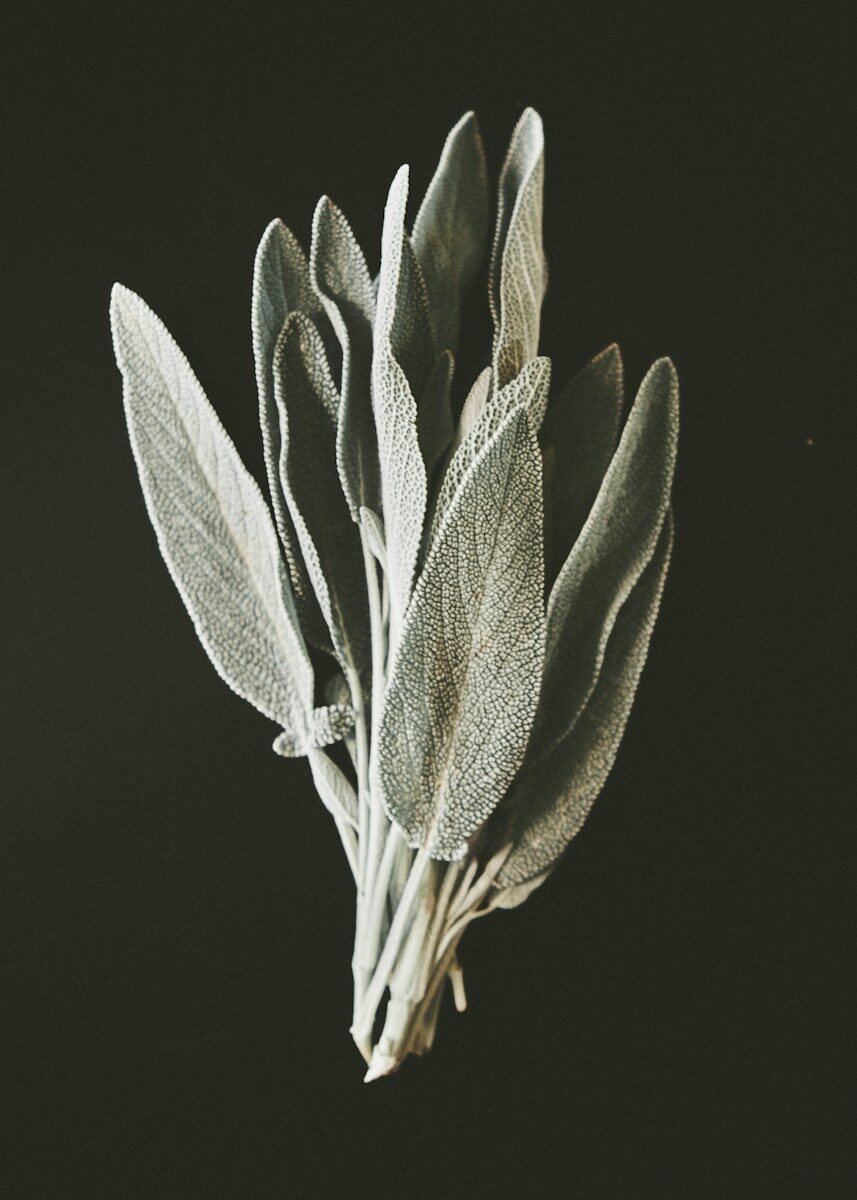
Sage is the herb European women were taking for sweating long before anyone ran a trial on it. The interesting thing is that, unlike most folk remedies, it has since been put through a handful of proper studies, and they mostly point the same way. Not all of them, and not perfectly, but enough that sage has a better case for night sweats than almost any other single plant. This is a walk through those studies, the doses they used, and the reasons a few people should leave it alone.
Why sweating, specifically
Sage leaf has a traditional reputation for reducing excessive sweating that is old enough and consistent enough that the European Medicines Agency lists “relief of excessive sweating” as one of its recognized traditional uses in the official herbal monograph. That is a statement about tradition, not about proof. But it explains why researchers looking for a plant to test against night sweats reached for sage rather than something else.
Nobody knows exactly how it works. Sage contains rosmarinic acid, flavonoids and a group of compounds called diterpenes, and there are laboratory findings suggesting some of these interact with estrogen receptors and with the nervous system’s control of sweating. None of that has been confirmed in people. What has been measured is whether women sweat less, so that is what the rest of this article is about.
The 2011 study that started it
The first modern clinical study came from Switzerland in 2011. Seventy-one women who were at least a year past their last period and having at least five hot flashes a day took one tablet of fresh sage leaf extract daily for eight weeks. Their flash score fell by half within four weeks and by 64% by week eight. Severe flashes fell by 79% and the very severe ones disappeared altogether. The women tolerated it well.
The catch, and it is a big one: there was no placebo group. Every woman knew she was taking sage. Hot flashes respond strongly to expectation, and in placebo arms of other menopause trials flash counts routinely drop by 20 to 30% on sugar pills. So the 2011 study told researchers that sage was worth testing properly. It did not tell them that it worked.
The placebo-controlled trials
Three followed, and they are the ones that matter.
Iran, 2019. A small double-blind trial in postmenopausal women compared sage extract tablets with placebo over a few weeks and reported lower overall menopause symptom scores in the sage group. It is the weakest of the three, being short and small, but it was the first to include a placebo.
Iran, 2020. This is the one to know about if night sweats are your problem, because it measured them separately. Sixty-six postmenopausal women were randomized to sage extract tablets, 100 mg three times a day, or matching placebo, for twelve weeks. Fifty-nine finished. The sage group had fewer and milder hot flashes, but the difference did not appear until weeks ten to twelve. Night sweat severity dropped significantly from week ten. Sleep quality, measured on the standard Pittsburgh scale, improved by nearly four points in the sage group, which is a change you would notice. The slow onset is worth remembering, and we come back to it below.
Germany, 2021. Eighty menopausal women aged 48 to 65 took either a fresh sage leaf tablet, the same product as the 2011 study, or placebo for four weeks. On the hot flash severity score, the sage group improved by 55% and the placebo group by 6%. Fifty-nine percent of women on sage cut their flash score at least in half, compared with 27% on placebo. The difference was statistically clear from week three. The three adverse events in the whole trial were shingles, a road accident and back pain, none of them plausibly caused by a herb.
One fair criticism of the German trial: 80 women were enrolled but only 48 were included in the main per-protocol analysis, which is a large drop and makes the headline percentages less solid than they look.
What the meta-analysis says
In 2023 a group pooled the four studies, 310 women in total, and this is where you get the honest bottom line. On hot flash frequency the pooled result favored sage, but the confidence interval just crossed zero, meaning the studies together could not rule out no effect. On hot flash severity the result was not significant. The authors concluded that sage “can be used to reduce the frequency of menopausal hot flashes” while calling for more research, which is about as far as the evidence stretches.
So where does that leave sage? Three placebo-controlled trials all pointing the same way, one of them showing a specific effect on night sweats and sleep, a pooled analysis that leans positive but is not conclusive, and a good safety record at the doses used. That is a real signal. It is not a proven treatment, and anyone who tells you sage “is clinically proven to stop night sweats” is overselling it. We think the accurate phrase is that sage is the best-studied herb for sweating and the studies so far are encouraging.
How much to take
The trials used two very different formats, which makes the question harder than it should be.
- The Swiss and German studies used one tablet a day of a fresh-leaf extract equivalent to about 3,400 mg of freshly picked sage. Fresh leaf is mostly water, so in dried-leaf terms that is somewhere under a gram a day.
- The Iranian studies used dried extract tablets, 100 mg each, taken one to three times a day, so 100 to 300 mg of extract.
Comparing those directly is not possible, because the extracts were made differently and nobody standardized them to the same marker compound. What you can say is that the effective range in the trials was roughly a gram of dried leaf a day or a few hundred milligrams of concentrated extract, taken every day, and that no trial found a benefit from taking more than that.
Sage tea is the traditional way, and the EMA monograph gives one to three cups a day of an infusion made from about 1 to 2 g of dried leaf. It is a reasonable option if you like the taste. It is hard to dose consistently and the German-style trials did not use it, so the trial results do not transfer neatly.
Two practical points from the trials. First, give it time. The German study saw a difference at three weeks but the Iranian night sweat study needed ten to twelve weeks, so anything under two months is not a fair test. Second, take it every day rather than when you feel sweaty. None of the trials used sage as an on-demand remedy.
Safety, and the thujone question
Sage leaf at normal doses is well tolerated, and the trials above reported nothing that looked like a drug effect. The one real safety issue is a compound called thujone, which is concentrated in sage essential oil and, in large amounts, can affect the nervous system and in extreme cases cause seizures. This is why sage essential oil should never be taken by mouth, and why the EMA sets an upper limit on thujone intake from herbal products. Water and alcohol extracts of the leaf, the kind used in the trials and in supplements, contain very little thujone, because it does not dissolve well in water. Tea and standard tablets are not the concern. Neat oil is.
Who should skip sage or ask first:
- Pregnancy and breastfeeding. Sage has a traditional reputation for reducing milk supply and there is no safety data in pregnancy. Avoid.
- Epilepsy or a seizure history. Because of thujone, even though leaf extracts contain little of it. Ask your neurologist.
- Diabetes medication. A few small studies suggest sage may lower blood sugar slightly. If you take insulin or sulfonylureas, mention it to whoever manages your diabetes.
- Sedatives or anticonvulsants. Possible additive effects on the nervous system. Ask a pharmacist.
- Hormone-sensitive conditions. Some sage compounds show weak estrogen receptor activity in the laboratory. There is no evidence of harm in people, but if you have had breast cancer, talk to your oncology team before adding any herb, sage included.
Where EQUILI fits
EQUILI contains 175 mg of sage leaf extract a day, a 10:1 water extract, which is equivalent to roughly 1,750 mg of dried leaf. That puts it within the range the trials used on a leaf-equivalent basis, though it is not the identical product to any of them and we do not claim it is. Sage is in the formula for one reason, which is that among the herbs with human trials for sweating it is the one with the most consistent results. It sits alongside 40 mg of red clover isoflavones for flashes, horsetail for hair and skin, and flaxseed lignans. The full review, including the limitations above, is in the ingredients glossary. If night sweats are your main complaint, sage is the ingredient in the formula doing that job, and eight to twelve weeks is the honest trial period.
References
- Bommer S, Klein P, Suter A. First time proof of sage’s tolerability and efficacy in menopausal women with hot flushes. Adv Ther. 2011. PMID 21630133.
- Dadfar F, Bamdad K. The effect of Salvia officinalis extract on the menopausal symptoms in postmenopausal women: an RCT. Int J Reprod Biomed. 2019. PMC6686654.
- Zeidabadi A, et al. The effect of Salvia officinalis extract on symptoms of flushing, night sweat, sleep disorders, and score of forgetfulness in postmenopausal women. J Family Med Prim Care. 2020. PMID 32318472.
- Wilfried D, Nina CDG, Bommer S. Effectiveness of Menosan Salvia officinalis in the treatment of a wide spectrum of menopausal complaints. A double-blind, randomized, placebo-controlled, clinical trial. Heliyon. 2021. DOI 10.1016/j.heliyon.2021.e05910.
- The effect of Salvia officinalis on hot flashes in postmenopausal women: a systematic review and meta-analysis. Int J Community Based Nurs Midwifery. 2023. PMID 37489230.
- European Medicines Agency, Committee on Herbal Medicinal Products. European Union herbal monograph on Salvia officinalis L., folium.
This article is for general information and is not a substitute for medical advice. EQUILI is a food supplement and is not intended to diagnose, treat, cure or prevent any disease. If you have a medical condition or take regular medication, speak to your doctor or pharmacist before taking any herbal product.