

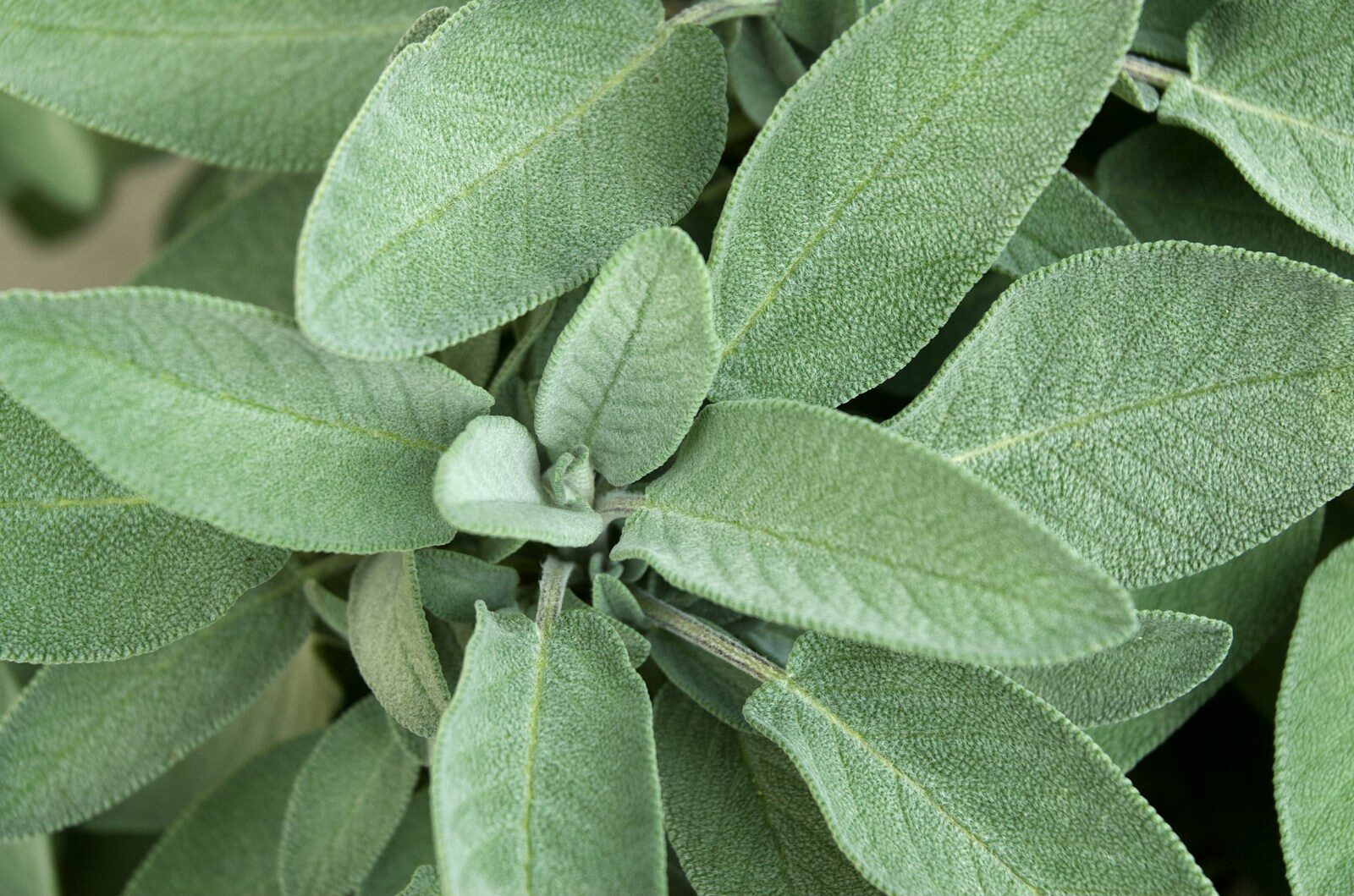
Sage (Salvia officinalis) is a culinary and medicinal herb with one of the longest documented traditions in women’s health — and, unusually among menopause botanicals, a tradition centered on sweating rather than on hormones. It is one of the four plants we chose for EQUILI, our daily menopause-support formula. This page sets out, in plain language and with references, what the research does and does not show about sage during the menopause transition.
What is in a sage leaf
Sage leaf is chemically rich. Its water-soluble fraction is dominated by rosmarinic acid (up to around 3% of the leaf) and related hydroxycinnamic acids, alongside flavonoids (about 1%, mainly luteolin and apigenin derivatives) and the phenolic diterpenes carnosic acid and carnosol. It also contains triterpenes such as ursolic acid, and an essential oil (up to about 3% of the leaf) made up largely of thujone, camphor and 1,8-cineole.
That last point matters more than it might appear, and we return to it under safety: the essential oil and the water- or alcohol-based leaf extracts used in supplements are chemically very different things, and they are not interchangeable.
Not a phytoestrogen — and that is the point
Red clover works, in theory, by supplying isoflavones that interact weakly with estrogen receptors. Sage does not appear to work this way, and it is worth being precise about that, because sage is often loosely described as a phytoestrogen.
When researchers set out specifically to identify how sage might affect hot flashes, a 2013 study found that a sage tincture showed no estrogenic effect overall, and no activity on serotonin reuptake or acetylcholinesterase. Only an isolated sub-fraction was estrogenic in a laboratory assay, and the compounds responsible were luteolin glycosides — flavonoids that are common across many edible plants rather than anything specific to sage. The authors’ own reading was that this reflects “common and ubiquitous estrogenic flavonoids.” Notably, the European Medicines Agency’s detailed assessment of sage leaf does not discuss estrogenic activity at all.
The honest position is therefore that sage’s mechanism in menopause is not established. The most-discussed hypothesis follows from its traditional use: sweat glands are controlled by cholinergic nerve signals, and an old observation that sage extract dampened pilocarpine-induced sweating is at least consistent with an action at that level. Laboratory work has also reported that a thujone-free fresh-leaf extract binds a range of receptors involved in thermoregulation and mood signaling. These are laboratory findings and hypotheses, not demonstrated mechanisms in women.
The traditional use: excessive sweating
Sage’s oldest and best-recognized application is not hot flashes as such, but excessive perspiration — a use documented in European herbal practice for centuries and formally recognized by EU regulators within the separate framework that governs traditional herbal medicines. Even there, the supporting clinical material is thin: the assessment cites open studies without control groups, some dating from the 1930s, plus one unpublished study. The tradition is genuine and long-standing. The modern trial evidence behind it is not strong.
What the research suggests: hot flashes and night sweats
Sage is frequently promoted for menopausal hot flashes on the strength of a much-quoted figure — a roughly 64% reduction in hot flash score over eight weeks. That figure is real, but the study behind it needs describing accurately: the 2011 trial by Bommer and colleagues followed 71 menopausal women taking a once-daily fresh sage leaf tablet, and it was an open, uncontrolled study with no placebo group and no blinding, conducted with the involvement of the manufacturer. In hot flash research this matters enormously, because placebo groups in controlled trials routinely record reductions of 20% to 50% or more. Without a control arm, a 64% improvement cannot be attributed to sage.
The more informative studies are the blinded ones, and there are only two:
- A double-blind, randomized, placebo-controlled trial published in 2021 gave 80 menopausal women a standardized extract of fresh sage or placebo for four weeks. Menopause Rating Scale scores fell by about 39% versus placebo (p = 0.002), and hot flash severity by about 55%, reaching significance from week three. Benefits appeared on the somato-vegetative and psychological subscales but not on the genito-urinary subscale, and sleep quality and fatigue improved. It is the best-designed study available — and it was small, ran only four weeks, and was sponsored by the manufacturer of the tested product.
- A double-blind randomized trial in 2020 gave 66 postmenopausal women 300 mg of sage extract daily for three months, reporting reductions in flushing, sleep disturbance and anxiety scores, along with improved sleep quality.
Set against these, the only meta-analysis to date — published in 2023 — pooled just four studies and 310 women. Its pooled estimate favored sage by roughly one fewer hot flash per day, but the confidence interval crossed zero and heterogeneity between studies was high, meaning the result did not reach conventional statistical significance. Its authors noted that the small number of trials and participants limited the ability to draw definitive conclusions.
The fair summary: the two blinded trials both point in a favorable direction, tolerability has been consistently good, and the traditional use is genuine — but the total randomized evidence amounts to a few small, short studies, the best of them industry-sponsored, and the pooled analysis is not statistically conclusive. This is “promising and well tolerated,” not “proven.”
Sleep, mood and mental clarity
Sage has a second, quite separate research literature on cognition and mood that is often cited in menopause contexts. It deserves care, because most of it was not conducted in menopausal women.
In healthy adults over 65, a placebo-controlled crossover study found that a single 333 mg dose of Salvia officinalis extract improved memory and attention over the course of a day. In younger adults, 300–600 mg of sage improved mood, alertness and performance under cognitive demand. A systematic review of sage and cognition concluded that the effects look beneficial but that methodological weaknesses and the sheer variety of preparations used make firm conclusions difficult.
Two caveats are important. Much of this literature used Salvia lavandulaefolia (Spanish sage) essential oil rather than Salvia officinalis leaf extract, and these are different preparations. And no sage trial has specifically measured “brain fog” in menopausal women — extending these findings to the menopause transition is an inference, not a result. What can be said is that the blinded 2021 menopause trial did report improvements in sleep quality, fatigue and psychological symptom scores alongside the vasomotor findings.
Safety, thujone, and who should take care
Sage has been well tolerated across the trials described above, with essentially no treatment-related adverse events reported, and no drug interactions are documented clinically. Two points nonetheless deserve straightforward explanation.
Thujone. Sage naturally contains thujone, a compound that acts on GABA-A receptors and can trigger seizures at high doses. The critical distinction is the preparation: thujone makes up a large share of sage essential oil, whereas water- and alcohol-based leaf extracts contain far less — a survey of 108 commercial sage products found tea infusions averaging around 9 mg of thujone per liter against roughly 107 mg per liter in tinctures. EU regulators recommend that daily thujone exposure from herbal products stay below 6 mg, with the amount specified for each batch. Sage essential oil taken internally is a different proposition altogether and is not considered to have a favorable benefit-risk balance.
Who should avoid it. Sage is not recommended during pregnancy or breastfeeding — it has a long folk use for reducing milk supply, although no clinical study has actually tested this. It is not recommended for anyone under 18. Because of the thujone question, sage supplements are not appropriate for people with epilepsy or a history of seizures. Anyone taking medication for diabetes should be aware that sage extract has lowered blood glucose in a controlled trial, and anyone with a hormone-sensitive condition or taking prescribed medicines should speak to their doctor or pharmacist first.
A note on health claims
Sage is sold in the EU as a food supplement, not a licensed medicine. Its menopause-related botanical health claims — including the proposed wording on contributing to menopausal comfort and to moderating sweating — remain “on hold” pending assessment under EU rules, which means no efficacy claim for sage has been formally authorized. EU regulators have separately recognized sage’s traditional use for excessive sweating within the distinct legal framework covering traditional herbal medicines. That is a different category from food supplements, and it is not a claim we make for EQUILI. The research summarized here is shared for general information — to explain why this plant is studied — and not as a promise of results.
Sage is a food supplement ingredient, not a medicine, and individual responses vary.
Sage in EQUILI
Each daily dose of EQUILI (2 capsules) provides 175 mg of sage leaf extract (a 10:1 water extract), alongside red clover, horsetail and flaxseed lignans — four plant ingredients traditionally associated with the menopause transition, brought together in one daily routine. Sage earns its place for a reason worth stating plainly: it works differently from the phytoestrogen ingredients beside it, which is precisely why we did not build the formula around a single plant.
References
- Bommer S, Klein P, Suter A. First time proof of sage’s tolerability and efficacy in menopausal women with hot flushes. Advances in Therapy. 2011. PubMed 21630133
- Dimpfel W, et al. Effectiveness of Menosan® Salvia officinalis in the treatment of a wide spectrum of menopausal complaints: a double-blind, randomized, placebo-controlled clinical trial. Heliyon. 2021. PMC7881233
- Zeidabadi A, et al. The effect of Salvia officinalis extract on symptoms of flushing, night sweat, sleep disorders, and score of forgetfulness in postmenopausal women. J Family Med Prim Care. 2020. PMC7114003
- Moradi M, et al. The effect of Salvia officinalis on hot flashes in postmenopausal women: a systematic review and meta-analysis. Int J Community Based Nurs Midwifery. 2023. PMC10363264
- Dadfar F, Bamdad K. The effect of Salvia officinalis extract on the menopausal symptoms in postmenopausal women. Int J Reprod Biomed. 2019. PMC6686654
- Rahte S, et al. Salvia officinalis for hot flushes: towards determination of mechanism of activity and active principles. Planta Medica. 2013. PubMed 23670626
- Tober C, Schoop R. Modulation of neurological pathways by Salvia officinalis and its dependence on manufacturing process and plant parts used. BMC Complement Altern Med. 2019. PMC6567565
- Scholey AB, et al. An extract of Salvia (sage) with anticholinesterase properties improves memory and attention in healthy older volunteers. Psychopharmacology. 2008. PubMed 18350281
- Kennedy DO, et al. Effects of cholinesterase inhibiting sage (Salvia officinalis) on mood, anxiety and performance on a psychological stressor battery. Neuropsychopharmacology. 2006. PubMed 16205785
- Miroddi M, et al. Systematic review of clinical trials assessing pharmacological properties of Salvia species on memory, cognitive impairment and Alzheimer’s disease. CNS Neurosci Ther. 2014. PMC6493168
- Franco OH, et al. Use of plant-based therapies and menopausal symptoms: a systematic review and meta-analysis. JAMA. 2016. PubMed 27327802
- Ghorbani A, Esmaeilizadeh M. Pharmacological properties of Salvia officinalis and its components. J Tradit Complement Med. 2017. PMC5634728
- Walch SG, et al. Determination of the biologically active flavour substances thujone and camphor in foods and medicines containing sage. Anal Chem Insights. 2012. PMC3317595
- Kianbakht S, Dabaghian FH. Improved glycemic control and lipid profile in hyperlipidemic type 2 diabetic patients consuming Salvia officinalis L. leaf extract. Complement Ther Med. 2013. PubMed 24050577
- European Medicines Agency, HMPC. European Union herbal monograph on Salvia officinalis L., folium (Rev. 1). ema.europa.eu
- European Medicines Agency, HMPC. Public statement on the use of herbal medicinal products containing thujone (Rev. 1). ema.europa.eu
- National Center for Complementary and Integrative Health (NCCIH). Sage. nccih.nih.gov
This page is for general information and is not a substitute for medical advice. Food supplements should not be used as a substitute for a varied, balanced diet and a healthy lifestyle.