
You wake up sweating again. Concentrating during the day feels harder, and by evening you would welcome anything that might help you feel more comfortable. Then you start looking at menopause supplements. One promises energy, another better sleep, and a third talks about “hormone balance”.
How do you choose when every description sounds convincing?
Start with what you want to improve. Addressing a nutrient shortfall and trying to reduce hot flashes are different goals. No single supplement has been reliably shown to help with every menopause symptom.
First, decide what you need help with
Before comparing ingredients, write down your main concern: “I want to wake up less often”, “Hot flashes are disrupting my day”, or “I want to know whether I get enough calcium”.
Related reading: Sleep problems during perimenopause and menopause.
That small step gives you something more useful to work with than a label saying “for women over 40”. It also makes a conversation with a pharmacist or doctor more productive: you can discuss a specific concern, your medicines and realistic expectations.
In the European Union, food supplements are intended to complement the normal diet. They are a different product category from medicines. A menopause label does not, by itself, establish a treatment benefit.
Do menopause supplements help with hot flashes?
Some ingredient studies report benefits, but the results are inconsistent. NICE guidance acknowledges some evidence that isoflavones or black cohosh may ease hot flashes, while highlighting differences between preparations, uncertain safety and possible medicine interactions.
The North American Menopause Society’s 2023 position statement does not recommend supplements or herbal remedies for treating hot flashes, based on its assessment of the overall evidence.
This helps explain why one article may describe a positive study while another says there is not enough evidence. An encouraging result alone does not establish a substantial, reliable benefit for the product you are considering.
What should you know about herbal ingredients?
Soy isoflavones
Isoflavones are phytoestrogens: plant compounds with a chemical structure similar to estrogen. That does not make them equivalent to menopausal hormone therapy.
Some research suggests that soy isoflavones may offer a small improvement in hot flashes, but findings have not been consistent. Any possible benefit needs to be considered alongside that uncertainty.
Red clover
Red clover (Trifolium pratense) also contains isoflavones. Studies of its effects on hot flashes have produced conflicting findings, and some have quality limitations. It is not possible to reliably predict who will benefit or by how much.
When reading a label, distinguish the amount of extract from the amount of isoflavones it contains. For example, “100 mg of extract” does not automatically mean “100 mg of isoflavones”.
Black cohosh
You may see black cohosh listed as Actaea racemosa or Cimicifuga racemosa.
Research on some extracts suggests a possible benefit. The US National Center for Complementary and Integrative Health (NCCIH) describes a 2023 review that found signs of improvement in overall menopause symptoms and hot flashes. This does not establish that every product will work equally well. Rare cases of liver damage have also been reported in people taking products labeled as black cohosh, although a causal link remains uncertain.
Sage
Sage (Salvia officinalis) extracts have been studied for hot flashes and other symptoms. In one 2021 trial, 80 women received a particular extract or a placebo—a preparation without the ingredient being tested—for four weeks. The study reported improvements, but a small, short trial leaves important questions unanswered.
Its findings cannot simply be applied to any sage tea or differently prepared extract. The details of what was tested matter.
Chasteberry
Chasteberry (Vitex agnus-castus) has been studied more extensively for premenstrual syndrome: symptoms that occur before a period. There is preliminary menopause research, but reliable evidence remains limited. Benefits for premenstrual symptoms cannot automatically be assumed to apply to menopause.
Vitamin D and calcium have a different role
Calcium is needed for bone health, and vitamin D helps the body absorb it. These are important nutritional needs. Their role in the body does not, however, establish that taking them as supplements will reduce hot flashes.
Calcium is available from foods such as dairy products, calcium-fortified plant drinks and canned fish eaten with their bones. Whether you need a supplement depends partly on how much your diet already provides.
Vitamin D supplementation should also have a clear purpose. If you use several products, check whether each contains vitamin D. Larger amounts do not automatically offer greater benefits, and excessive intake can be harmful.
How to read a menopause supplement label
An ingredient list becomes easier to understand when you break it down.
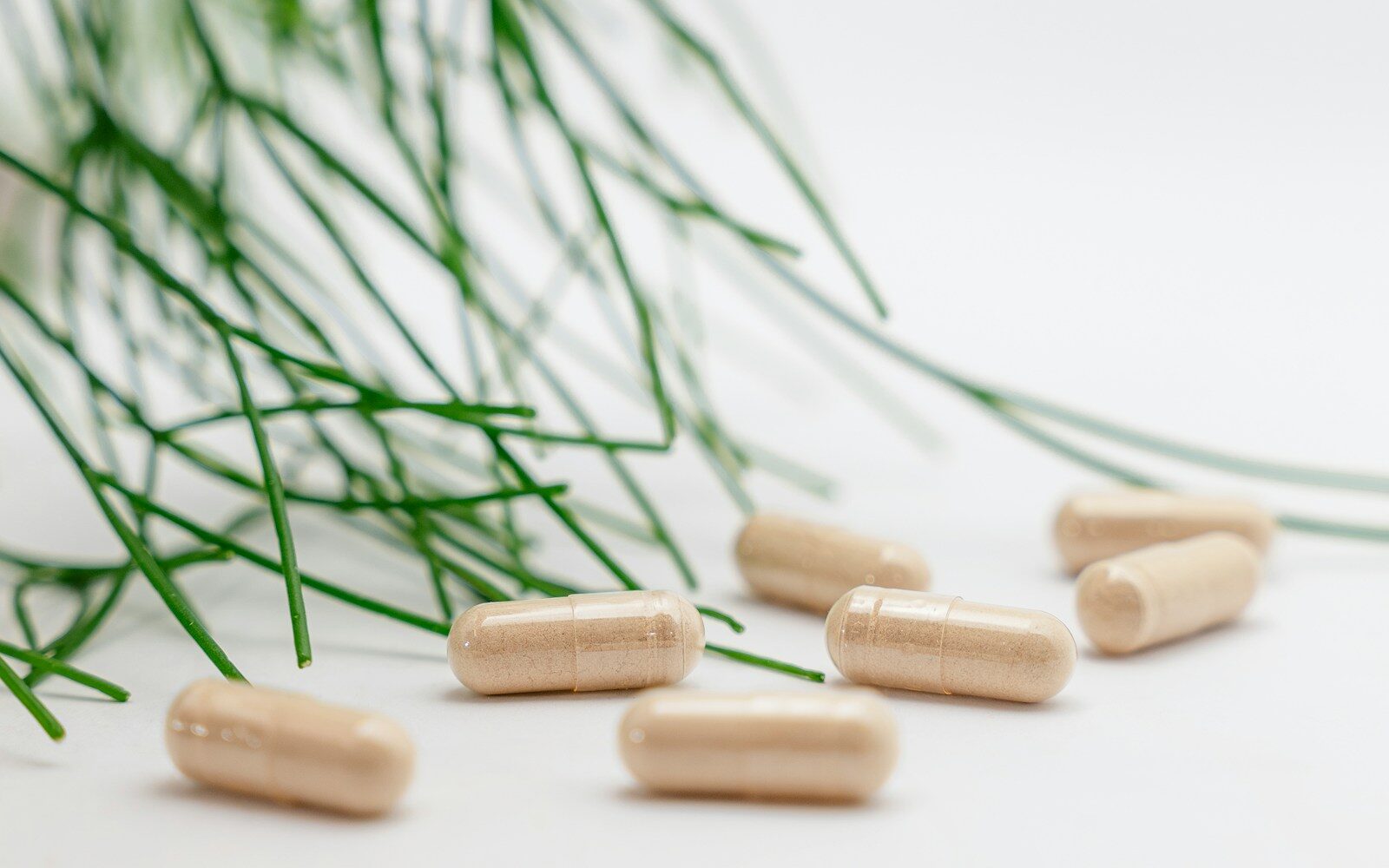
Check the daily serving first. If one capsule contains 50 mg of an extract and the suggested serving is two capsules, the daily amount is 100 mg. Make sure you are comparing like with like.
Look for the plant name and the part used. Roots, leaves and fruits are not interchangeable descriptions. An extract is a preparation made by drawing substances out of plant material; its composition also depends on how it is prepared.
Look for amounts of specified compounds. Standardization aims to keep selected substances at consistent levels between batches. It can help clarify composition, but the word itself is not a guarantee of effectiveness.
For example, a daily serving containing 100 mg of extract standardized to 20% isoflavones provides 20 mg of isoflavones. This is an illustration of label reading, not a recommended dose.
Ask what was actually studied. Was it the finished product, the same extract, or simply the plant in general? A longer ingredient list does not establish a stronger effect. Studies of individual ingredients do not prove the benefits of a particular combination.
Finally, compare the cost per recommended daily serving. A bottle of 60 capsules lasts 30 days if the serving is two capsules a day. That gives you a clearer comparison than the size of the bottle alone.
“Natural” does not mean suitable for everyone
Herbal ingredients can cause side effects and interact with medicines. Show the ingredient list to a pharmacist or doctor before starting a new supplement, particularly if you take regular medication, are receiving cancer treatment, have a history of breast cancer or have liver disease.
If you develop dark urine, yellowing of the skin or other possible signs of liver trouble while taking black cohosh, stop using it and seek medical advice.
Keeping one list of all your medicines and supplements is a useful everyday precaution. It makes overlapping ingredients and combinations easier to discuss.
How can you tell whether a supplement is helping?
If you decide to try a supplement after discussing its suitability, agree on a point at which to review it. There is no single evidence-based timetable that applies to every ingredient.
A simple symptom record can help: note how often you wake, how frequently hot flashes occur, and how much they interfere with work or daily life. Avoid starting several new products at once, because it becomes harder to understand what coincided with a change.
If there is no clear benefit, reconsider the choice. You do not need to keep buying another bottle simply because you have already started.
What if supplements are not enough?
When symptoms disrupt everyday life, there are other options to discuss. These include menopausal hormone therapy when suitable and evidence-based nonhormonal treatment for hot flashes. Menopause-specific cognitive behavioral therapy can help address responses and habits associated with symptoms.
You do not need to memorise every botanical name to make an informed choice. Focus on three questions: What do I want to improve? What supports this choice? How will I judge whether it helps? Those questions make it easier to choose calmly, with your own needs and budget in mind.
References
- NCCIH. Menopausal Symptoms: In Depth.
- NICE. Menopause: identification and management (NG23).
- The North American Menopause Society. 2023 nonhormone therapy position statement. Menopause. 2023. DOI: 10.1097/GME.0000000000002200.
- European Commission. Food supplements.
- NCCIH. Soy.
- NCCIH. Red Clover.
- NCCIH. Black Cohosh.
- Randomized placebo-controlled trial of a sage extract. Heliyon. 2021;7:e05910. DOI: 10.1016/j.heliyon.2021.e05910.
- NCCIH. Chasteberry.
- NIH Office of Dietary Supplements. Calcium: consumer fact sheet.
- NIH Office of Dietary Supplements. Vitamin D: consumer fact sheet.
- NIH Office of Dietary Supplements. Background information on dietary supplements.
- NIH Office of Dietary Supplements. Botanical supplement background information.
- NCCIH. Using Dietary Supplements Wisely.
Sources checked on 13 October 2026. This article provides general information and does not replace individual advice from a qualified healthcare professional.