
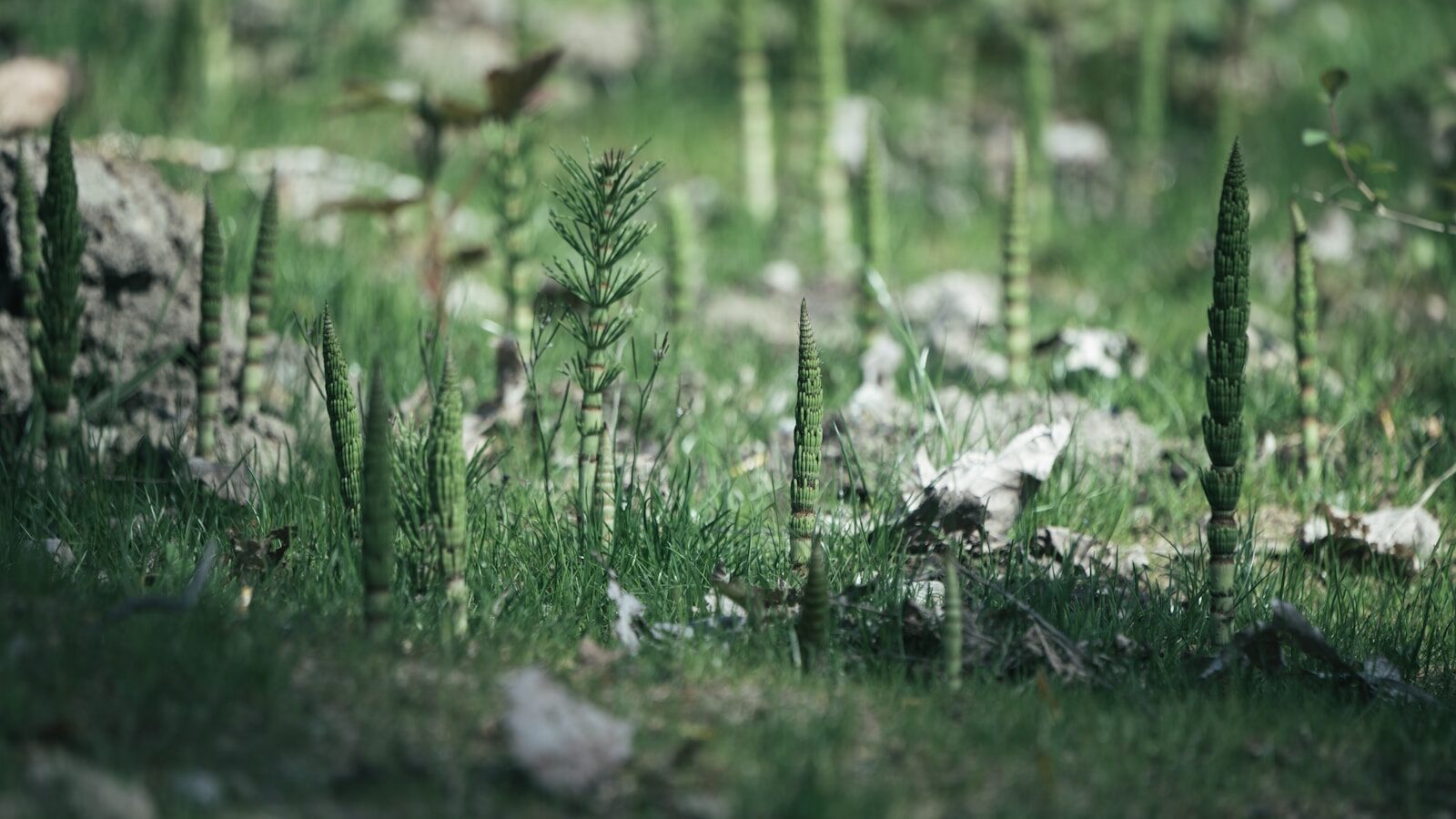
Horsetail (Equisetum arvense) is a survivor. Its relatives dominated the forests of the Carboniferous period, and the plant growing in European hedgerows today is one of the oldest still with us. It is also the richest known plant source of silica — the mineral form of silicon. It is one of the four plants we chose for EQUILI, our daily menopause-support formula. This page sets out what the research does and does not show about horsetail, including where the evidence is genuinely thin.
What is in horsetail
Horsetail’s best-known constituent is silicic acid and silicates, at roughly 5–7.7% of the dried herb. But it is not only silica: the herb also contains flavonoids (mainly kaempferol and quercetin glycosides, with isoquercitrin prominent — the European Pharmacopoeia requires a minimum of 0.3% total flavonoids), caffeic acid derivatives, styrylpyrones, sterols and triterpenoids. Laboratory work suggests both the silica and the flavonoid isoquercitrin contribute to its measurable activity, so describing horsetail purely as “a silica plant” undersells its chemistry.
The silicon question, asked honestly
Here is the part usually skipped. Horsetail’s headline silica figure is total silica, and most of it is locked in an insoluble, polymerized mineral form — biogenic silica, essentially plant glass. European regulators’ own assessment cites work finding that while whole-plant silicon is about 5%, the maximum water-extractable silicon was only around 0.3% of the plant.
Absorption follows the same pattern. In human studies comparing silicon sources, monomeric forms such as orthosilicic acid and the silicon in beer were absorbed at 43–64% of the dose, while colloidal (polymerized) silica was absorbed at about 1%. Form matters enormously.
Does silicon from horsetail actually reach the bloodstream? There is exactly one human study, published in 2022: twelve healthy men drank a liter of concentrated horsetail tea, and serum silicon rose measurably. That is real evidence of absorption — but it was a small pilot in men only, used a liter of very concentrated infusion rather than a capsule, included no bone or health outcome of any kind, and the stronger brew caused diarrhea in four of the twelve participants. It is a starting point, not a foundation.
Why bone matters during menopause
This context is worth stating on its own terms, separately from anything about horsetail. When estrogen falls at menopause, calcium absorption decreases and bone resorption accelerates. Women lose on average about 1% of bone mineral density per year after menopause, and roughly 30% of postmenopausal women in Europe and the United States have osteoporosis. That is why bone comes up so often in menopause conversations — and why it attracts a great deal of supplement marketing.
What the research suggests: silicon and bone
Silicon’s interest for bone goes back to Edith Carlisle’s work in the 1970s, which found that silicon-deficient chicks developed abnormal bone and cartilage, apparently through effects on collagen and the organic bone matrix. It is a real and interesting line of research — though notably, a careful 2008 attempt to reproduce that profound deficiency state in rats was unable to do so.
In humans, the picture is more complicated, and in a way that matters here. The largest observational study — the Framingham Offspring cohort, nearly 2,850 adults — found dietary silicon intake positively associated with hip bone density in men and premenopausal women, but not in postmenopausal women. That qualification is in the paper’s own title. A separate cohort of over 3,000 women aged 50–62 in Aberdeen reached a compatible conclusion: the silicon–bone association appeared only in “estrogen-replete” women, meaning those still premenopausal or taking HRT, leading the authors to conclude that estrogen status governs how silicon acts in bone.
Supplement trials have not closed the gap. The main randomized trial in osteopenic women used choline-stabilized orthosilicic acid — a manufactured silicon source, not horsetail — alongside calcium and vitamin D for a year. Lumbar spine bone density did not change significantly. The femoral neck result was significant only in a post-hoc subgroup, and one bone-formation marker improved without a clear dose-response. And in the study that tests the idea most directly, postmenopausal women drinking silicon-rich water for 12 weeks absorbed the silicon demonstrably — but showed no change in any marker of bone formation or resorption.
As for horsetail specifically: there is no human trial of Equisetum arvense with any bone outcome — not bone density, not bone turnover markers, not fractures. What exists is laboratory and animal work, including ovariectomized-rat and aged-mouse models and studies on human bone cells in culture. That work is interesting and points in a favorable direction, but it is preclinical, and some of it involves horsetail combined with other active nutrients so its individual contribution cannot be separated.
Hair, skin and nails: what was actually tested
Horsetail is widely marketed for hair, skin and nails, so it is worth being precise about where that evidence comes from, because in most cases it is not oral horsetail.
The frequently cited nail research tested a topical nail lacquer combining hydroxypropyl chitosan, horsetail extract and methylsulfonylmethane, mostly in nail psoriasis. The film-forming chitosan is the presumed active, horsetail’s contribution was never isolated, and none of it was an oral supplement. The skin and hair trials most often quoted used choline-stabilized orthosilicic acid — again, a different silicon source, not horsetail. And the well-known hair-thinning studies used a multi-ingredient marine-protein supplement that contains horsetail among several components including biotin and zinc. They were manufacturer-funded, compared against an inert placebo rather than the same formula without horsetail, and one of them specifically excluded women who had used HRT or hormonal contraception in the previous six months.
The honest summary: no human trial has tested oral horsetail on its own for hair, skin or nails. The rationale is mechanistic and traditional, not demonstrated.
Where horsetail’s evidence is strongest
Ironically, horsetail’s best human evidence has nothing to do with bone or hair. A double-blind randomized crossover trial in 36 healthy volunteers found that a standardized horsetail dry extract at 900 mg/day produced a diuretic effect equivalent to hydrochlorothiazide over four days, without significant changes in electrolyte elimination. This aligns with horsetail’s oldest documented use, and it is the only indication EU regulators recognize for the plant — within the separate legal framework covering traditional herbal medicines, for increasing urine flow to flush the urinary tract. That study was in men only and lasted four days, so it should not be over-read either.
Safety, quality and who should take care
Two quality issues deserve plain explanation, because they are the reason sourcing matters more for horsetail than for most botanicals.
Species identity. Horsetail’s close relative Equisetum palustre (marsh horsetail) contains toxic piperidine alkaloids such as palustrine, which are absent from genuine Equisetum arvense. This is not theoretical: an analysis of 34 retail horsetail products found 26 of them — 76% — positive for these marker alkaloids, indicating contamination with the wrong species. The European Pharmacopoeia requires a specific identity test for exactly this reason. Because the alkaloids are absent from true E. arvense, their presence is a clean, testable marker of adulteration — which makes verified species identity a real quality question to ask of any horsetail product, ours included.
Thiaminase. Horsetail contains an enzyme that degrades thiamine (vitamin B1) — the basis of historical poisoning in grazing horses. The reassuring part is that this enzyme is heat- and solvent-sensitive: it is inactivated above about 80°C and has not been detected in industrial aqueous or ethanolic dry extracts. Regulators concluded no special labeling is needed for extract preparations, while noting that unheated, unextracted plant powder does not benefit from that reassurance.
Beyond this: horsetail also contains trace nicotine (typically under 0.25 mg per kg of dried herb, a nutritionally irrelevant amount, though relevant to anyone with a known nicotine sensitivity). Mild gastrointestinal complaints and allergic reactions have been reported. Horsetail is not recommended during pregnancy or breastfeeding, or for anyone under 18. It is not appropriate for people advised to restrict fluid intake, such as those with serious heart or kidney conditions. No drug interactions are documented clinically, but anyone taking prescribed medication — particularly diuretics or lithium — should speak to their doctor or pharmacist first.
A note on health claims
Horsetail is sold in the EU as a food supplement, not a licensed medicine. When EFSA reviewed the proposed claims for Equisetum arvense in 2009 — covering invigoration, skin, hair, bone and body weight — it concluded that the plant had not been sufficiently characterized for those purposes, and no claim was authorized. Claims for silicon itself, including bone maintenance and contribution to collagen and connective tissue formation, were separately assessed and are listed as non-authorized on the EU register. Botanical claims more broadly remain unresolved pending a European Commission decision.
EU regulators have separately recognized horsetail’s traditional use for flushing the urinary tract, within the distinct framework covering traditional herbal medicines — a different legal category from food supplements, with no bone, hair, skin or menopause indication attached. The research summarized here is shared for general information, not as a promise of results.
Horsetail is a food supplement ingredient, not a medicine, and individual responses vary.
Horsetail in EQUILI
Each daily dose of EQUILI (2 capsules) provides 120 mg of horsetail extract, alongside red clover, sage and flaxseed lignans. Horsetail is included as a traditional, silica-rich botanical that complements the other three rather than duplicating them — and we would rather tell you plainly that its clinical evidence is limited than imply otherwise. Given what the retail-market analysis above shows about species contamination, verified botanical identity is the part of horsetail sourcing that genuinely matters.
References
- Jugdaohsingh R, et al. Dietary silicon intake is positively associated with bone mineral density in men and premenopausal women of the Framingham Offspring cohort. J Bone Miner Res. 2004. PubMed 14969400
- Macdonald HM, et al. Dietary silicon interacts with oestrogen to influence bone health: evidence from the Aberdeen Prospective Osteoporosis Screening Study. Bone. 2012. PubMed 22173054
- Sripanyakorn S, et al. The comparative absorption of silicon from different foods and food supplements. Br J Nutr. 2009. PMC2744664
- Waterstradt A, et al. Silicon bioavailability from horsetail tea: a randomised pilot study in healthy volunteers. Planta Medica. 2022. PubMed 34706374
- Spector TD, et al. Choline-stabilized orthosilicic acid supplementation as an adjunct to calcium/vitamin D3 stimulates markers of bone formation in osteopenic females. BMC Musculoskelet Disord. 2008. PMC2442067
- Li Z, et al. Absorption of silicon from artesian aquifer water and its impact on bone health in postmenopausal women: a 12 week pilot study. Nutr J. 2010. PMC2967495
- Carlisle EM. Biochemical and morphological changes associated with long bone abnormalities in silicon deficiency. J Nutr. 1980. PubMed 7373430
- Jugdaohsingh R, et al. Increased longitudinal growth in rats on a silicon-depleted diet. Bone. 2008. PMC2832730
- Carneiro DM, et al. Randomized, double-blind clinical trial to assess the acute diuretic effect of Equisetum arvense (field horsetail) in healthy volunteers. Evid Based Complement Alternat Med. 2014. PMC3960516
- Nowak M, et al. Biomarker-based determination of Equiseti herba contamination by Equisetum palustre using HPLC-MS/MS. Planta Medica. 2022. PubMed 34293807
- Tipke I, et al. Equisetum alkaloids including nicotine across the genus. Phytochem Anal. 2019. PubMed 31115949
- Mimica-Dukic N, et al. Phenolic compounds in field horsetail (Equisetum arvense L.) as natural antioxidants. Molecules. 2008. PubMed 18719517
- Steinborn C, et al. Immunomodulatory effects of metabolites of horsetail (Equisetum arvense). Planta Medica. 2018. PubMed 29202511
- Costa-Rodrigues J, et al. Inhibition of human in vitro osteoclastogenesis by Equisetum arvense. Cell Prolif. 2012. PMC6495422
- Barel A, et al. Effect of oral intake of choline-stabilized orthosilicic acid on skin, nails and hair in women with photodamaged skin. Arch Dermatol Res. 2005. PubMed 16205932
- Ablon G. A 3-month randomized, double-blind, placebo-controlled study evaluating the ability of a marine complex supplement to promote hair growth in women with self-perceived thinning hair. Dermatol Res Pract. 2015. PMC4389977
- European Medicines Agency, HMPC. European Union herbal monograph and assessment report on Equisetum arvense L., herba. ema.europa.eu
- European Commission. EU Register on nutrition and health claims. ec.europa.eu
- NIH Office of Dietary Supplements. Calcium — Health Professional Fact Sheet. ods.od.nih.gov
- LiverTox: Clinical and Research Information on Drug-Induced Liver Injury — Horsetail. NCBI Bookshelf. NBK583202
This page is for general information and is not a substitute for medical advice. Food supplements should not be used as a substitute for a varied, balanced diet and a healthy lifestyle.