
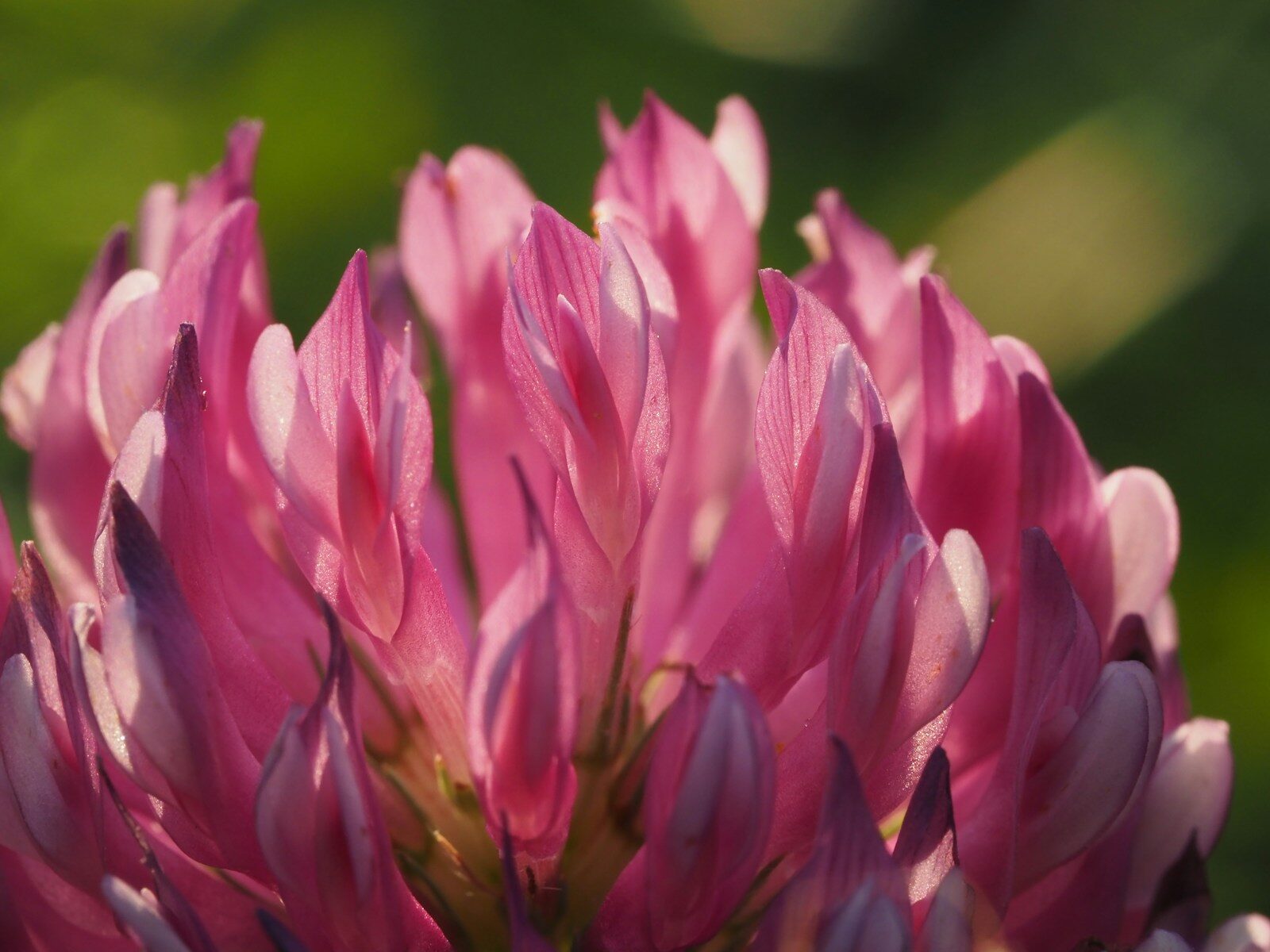
Red clover (Trifolium pratense) is a flowering legume with a long history of use in women’s health, and one of the richest natural sources of isoflavones — plant compounds classed as phytoestrogens because their structure resembles the body’s own estrogen, though their activity is far weaker. It is one of the four botanicals we chose for EQUILI, our daily menopause-support formula. This page reviews, in plain language and with references, what the research does and does not show about red clover during the menopause transition.
The isoflavones in red clover
Red clover’s activity is attributed mainly to four isoflavones. Two of them — biochanin A and formononetin — dominate, alongside smaller amounts of genistein and daidzein. Standardized extracts are usually described by their isoflavone content: the red clover tablets used in clinical trials have typically supplied around 40 mg of isoflavones each, so the doses most often studied (40–80 mg per day) correspond to one or two tablets.
Why the gut microbiome matters
On their own, biochanin A and formononetin are “methylated” precursors with limited activity. The interesting chemistry happens in the gut: resident bacteria convert biochanin A into genistein and formononetin into daidzein, and in some people daidzein is transformed a step further into equol, a metabolite with notably greater estrogen-like potency. Crucially, not everyone carries the bacteria needed to make equol. Research describes distinct “equol-producer” and “non-producer” populations, and equol producers tend to show the strongest responses to isoflavones. This is one of the leading explanations for why individual results vary so much — and why the make-up of your microbiome sits at the heart of how these plant compounds work.
Why red clover is studied in menopause
During the menopause transition the ovaries produce less estrogen, a change linked to hot flashes, night sweats and other symptoms. Because isoflavones can bind — weakly, and with an apparent preference for the beta-type estrogen receptor — to the same receptors as estrogen, researchers have asked whether they might ease some of these symptoms. It is a plausible hypothesis that has been tested in many trials, with genuinely mixed results.
What the research suggests: hot flashes
Red clover is among the more studied botanicals for menopausal hot flashes, and the honest summary is that the evidence is mixed.
On the encouraging side, a 2021 systematic review and meta-analysis of randomised controlled trials (Kanadys et al., Nutrients) reported a statistically significant reduction in the daily frequency of hot flashes with red clover compared with placebo — on the order of roughly two fewer flashes per day — with the clearest signal in trials lasting about 12 weeks. A 2017 meta-analysis restricted to the standardized extract Promensil at 80 mg/day (Myers & Vigar) found a larger reduction of about three to four fewer flashes per day. Smaller individual trials — such as van de Weijer & Barentsen (2002) and Lipovac et al. (2012), both using 80 mg of isoflavones daily — also reported meaningful reductions.
On the more sobering side sit the most independent syntheses. A 2016 meta-analysis (Ghazanfarpour et al.) found a reduction that fell just short of statistical significance, with very high variability between studies. An earlier review (Coon et al., 2007) described only a marginal effect of unclear clinical importance. And the Cochrane review of phytoestrogens for menopausal vasomotor symptoms (Lethaby et al., 2013) — widely regarded as the most rigorous independent assessment — pooled the red clover trials and found no significant difference from placebo, while also noting a strong placebo response in this area. The large comparative ICE trial (Tice et al., JAMA, 2003) likewise found no clinically important advantage over placebo.
Taken together, some trials and product-specific analyses point to a modest benefit for hot flashes, but the most rigorous independent review is neutral, and results differ widely from study to study — partly, perhaps, because of the equol-producer differences described above. Where a benefit appears, it is best understood as modest and not consistently reproduced.
Beyond hot flashes
Researchers have looked at other outcomes too, mostly in small studies:
- Bone: a one-year randomised trial (Atkinson et al., 2004) found red clover isoflavones were associated with less bone-mineral loss at the lumbar spine, though not at the hip. This is a single study using a surrogate marker (bone density), not evidence about fractures.
- Blood vessels and cholesterol: several small trials (e.g. Nestel et al., 1999; Teede et al., 2003) reported improved arterial compliance — a measure of how flexible the arteries are — but effects on cholesterol and other blood lipids have been inconsistent, with the better-controlled trials often showing no change.
- Vaginal comfort: a placebo-controlled crossover study (Hidalgo et al., 2005) reported improvements in vaginal cell measures alongside symptom relief, but this rests on a single small trial and a surrogate outcome.
- Mood: a crossover trial (Lipovac et al., 2010) reported reductions in anxiety and low-mood scores. It was small, came from a single research group, and awaits independent replication.
Across all of these, the studies are small, sometimes from the same research groups, and the findings are best read as preliminary rather than established.
Safety and who should take care
At the doses studied, red clover isoflavones have generally been well tolerated in trials lasting up to two years. Reassuringly, a one-year trial found that red clover isoflavones did not increase mammographic breast density (in contrast to conventional hormone therapy), and the Cochrane review found no sign of estrogen-like stimulation of the womb lining or vaginal tissue over up to two years of use.
That said, because isoflavones are mildly estrogenic, caution is sensible for anyone with an estrogen-sensitive condition (such as breast, ovarian or womb cancer, or endometriosis). The safety of red clover supplements specifically in people with these cancers has not been established. Red clover is not recommended during pregnancy or breastfeeding. And because plant compounds can interact with medicines, anyone taking hormone therapy, tamoxifen or blood-thinning medication should speak to their doctor or pharmacist before using it.
A note on health claims
Red clover is sold in the EU as a food supplement, not a licensed medicine. Its menopause-related botanical health claims are among the many that remain “on hold” pending assessment under EU rules, which means no efficacy claim for red clover has been formally authorized. The research summarised above is shared for general information — to explain why this botanical is studied — and not as a promise of results.
Red clover is a food supplement ingredient, not a medicine, and individual responses vary.
Red clover in EQUILI
Each daily dose of EQUILI (2 capsules) provides 200 mg of red clover extract standardized to 20% isoflavones — 40 mg of isoflavones a day, made from the flower and stem by water-and-ethanol extraction and verified by HPLC on every batch, the amount used in most of the trials above and in the longest safety study. It sits alongside sage, horsetail and flaxseed lignans — four plant ingredients traditionally associated with the menopause transition, brought together in one daily capsule routine. Because red clover’s isoflavones are activated by your gut bacteria, it fits naturally with the microbiome-focused thinking at the heart of Le Microbiome.
References
- Kanadys W, et al. Evaluation of clinical meaningfulness of red clover (Trifolium pratense) extract to relieve hot flushes and menopausal symptoms: a systematic review and meta-analysis of RCTs. Nutrients. 2021. PMC8069620
- Myers SP, Vigar V. Effects of a standardized extract of Trifolium pratense (Promensil) at 80 mg in the treatment of menopausal hot flushes: a systematic review and meta-analysis. Phytomedicine. 2017. PubMed 28160855
- Ghazanfarpour M, et al. Red clover for treatment of hot flashes and menopausal symptoms: a systematic review and meta-analysis. J Obstet Gynaecol. 2016. PubMed 26471215
- Coon JT, Pittler MH, Ernst E. Trifolium pratense isoflavones in the treatment of menopausal hot flushes: a systematic review and meta-analysis. Phytomedicine. 2007. PubMed 17239573
- Lethaby A, et al. Phytoestrogens for menopausal vasomotor symptoms. Cochrane Database of Systematic Reviews. 2013. PubMed 24323914
- Tice JA, et al. Phytoestrogen supplements for the treatment of hot flashes: the Isoflavone Clover Extract (ICE) Study. JAMA. 2003. PubMed 12851275
- van de Weijer PH, Barentsen R. Isoflavones from red clover (Promensil) significantly reduce menopausal hot flush symptoms compared with placebo. Maturitas. 2002. PubMed 12161042
- Atkinson C, et al. The effects of phytoestrogen isoflavones on bone density in women: a double-blind, randomized, placebo-controlled trial. Am J Clin Nutr. 2004. PubMed 14749241
- Atkinson C, et al. Red-clover-derived isoflavones and mammographic breast density: a double-blind, randomized, placebo-controlled trial. Breast Cancer Research. 2004. PMC400670
- Nestel PJ, et al. Isoflavones from red clover improve systemic arterial compliance but not plasma lipids in menopausal women. J Clin Endocrinol Metab. 1999. PubMed 10084567
- Hidalgo LA, et al. The effect of red clover isoflavones on menopausal symptoms, lipids and vaginal cytology in menopausal women: a randomized, double-blind, placebo-controlled study. Gynecol Endocrinol. 2005. PubMed 16373244
- Lipovac M, et al. Improvement of postmenopausal depressive and anxiety symptoms after treatment with isoflavones derived from red clover extracts. Maturitas. 2010. PubMed 19948385
- Setchell KDR, Brown NM, Lydeking-Olsen E. The clinical importance of the metabolite equol — a clue to the effectiveness of soy and its isoflavones. J Nutr. 2002. PubMed 12468591
- Booth NL, et al. Clinical studies of red clover (Trifolium pratense) dietary supplements in menopause: a literature review. Menopause. 2006. PubMed 16645539
- National Center for Complementary and Integrative Health (NCCIH). Red Clover. nccih.nih.gov
This page is for general information and is not a substitute for medical advice. Food supplements should not be used as a substitute for a varied, balanced diet and a healthy lifestyle.